
Hearing that you don’t have enough bone for dental implants can feel like a dead end, but it is actually one of the most common obstacles patients face on the road to a restored smile. Bone loss in the jaw can result from a variety of factors: tooth loss left untreated over time, gum disease, injury, or even changes that occur naturally as we age. The good news is that modern periodontal care has made this hurdle very manageable, and being told you lack sufficient bone today does not mean implants are off the table.
At Middlesex Periodontics & Dental Implants in East Brunswick, New Jersey, Dr. Daniel Reich and our team work with patients every day who arrive having been told they are not candidates for dental implants elsewhere. As a Diplomate of the American Board of Periodontology with over 25 years of experience, Dr. Reich thoroughly evaluates each patient’s jaw structure and recommends solutions to restore the foundation required for successful implant placement. No referral is needed to get started.
Why Bone Volume Matters for Implants
Dental implants are titanium posts placed directly into the jawbone, where they fuse with surrounding bone tissue through a process called osseointegration. This fusion is what makes implants so stable and long-lasting compared to other tooth replacement options. For osseointegration to succeed, there must be adequate bone height and width at the implant site, enough to fully surround the post and anchor it securely.
If you lose a tooth and don’t get it replaced quickly, your jawbone starts to shrink because it’s not being used anymore. Jawbone loss and deterioration can happen fast, sometimes making it tricky to place an implant just a year or two later. Gum disease makes this even worse since the infection eats away at the bone and tissue holding your teeth in place. The longer you wait, the more complicated the fix becomes, which is why checking in with a periodontist sooner rather than later is a smart move.
How Can Bone Grafting Rebuild What Was Lost?
Bone grafting is the most well-established approach to restoring jaw volume before implant placement. According to research published in PubMed Central, bone grafting is required in approximately 25% one dental implant procedures, making it a routine and predictable part of the implant process. A graft introduces new bone material to the deficient site, which the body then integrates over several months, creating the solid foundation an implant requires.
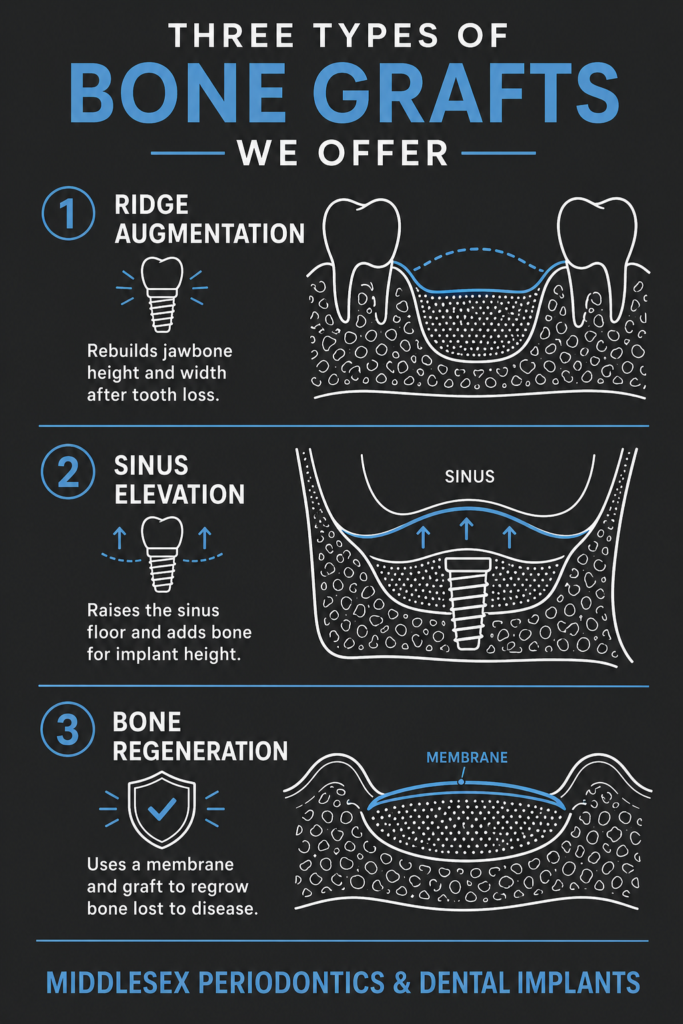
Our team does a few different types of bone grafts, depending on where you need it and how much bone has been lost. We’ll tailor the plan to your specific goals. Here are the most common options we offer:
- Ridge augmentation: Used to rebuild the height and width of the jawbone ridge after tooth loss or extraction, ridge augmentation restores the contour of the jaw and creates the proper environment for implant placement.
- Sinus elevation: When bone volume is insufficient in the upper back jaw due to the sinus cavity sitting too low, a sinus lift procedure raises the sinus floor and adds bone material below it, creating the necessary height.
- Bone regeneration: In cases where gum disease has eroded bone around existing teeth or previous implant sites, guided bone regeneration uses barrier membranes alongside graft material to encourage the regrowth of lost bone.
A thorough overview of bone grafting helps patients understand which path best fits their situation. After a graft is placed, healing typically takes several months before implant placement can proceed, though in some cases, implant placement and grafting can be performed simultaneously.
What Happens During Your Evaluation
Before recommending any procedure, Dr. Reich performs a comprehensive evaluation that includes 3D imaging to map the exact dimensions of your jaw. This imaging allows him to see precisely where bone volume is lacking and how much grafting, if any, will be needed. Patients are often surprised to learn how predictably modern bone grafting techniques rebuild jaw structure when performed by a trained periodontist.
Planning for Long-Term Success
Once grafting is complete and healing has occurred, bone grafting for implants sets the stage for a straightforward implant procedure. Dr. Reich uses 3D printing technology to create precise surgical guides, which improve accuracy during implant placement and contribute to better outcomes. From single-tooth implants to full arch restorations, the plan is designed around your long-term oral health, not just the immediate procedure.
For patients who need significant jaw reconstruction before implants, a ridge augmentation procedure may be recommended as a foundational step. Our team walks patients through every phase of the process so there are no surprises, and we are available to answer questions from the first consultation through final restoration.
Choose Middlesex Periodontics & Dental Implants for Your Bone Grafting Needs
Bone loss does not have to stand between you and a complete, functional smile. At Middlesex Periodontics & Dental Implants, Dr. Daniel Reich brings board-certified periodontal training and decades of hands-on experience to every patient evaluation. Dr. Reich completed his D.M.D. at the University of Pennsylvania and his periodontal residency at SUNY Stony Brook, and he currently serves as Director and Associate Professor of Periodontics at Touro College of Dental Medicine. Our practice welcomes patients without a referral and offers same-day emergency appointments for urgent concerns. Financing is available through Cherry Financing, and we accept Delta Dental Premier and Cigna PPO insurance.
If you have been told implants are not possible because of bone loss, we encourage you to come in for an evaluation. Reach our East Brunswick office at 732-257-7300 or use our contact form to schedule a consultation and take the first step toward rebuilding your smile.