
If you have been weighing your options for replacing missing teeth across an entire arch, the comparison between snap-in dentures and full arch dental implants can feel overwhelming. Both solutions rely on implants placed into the jawbone, both offer a dramatic upgrade from traditional dentures, and both have the potential to restore your smile for years to come. The real question is not which option exists, but which one fits the way you actually want to live.
At Middlesex Periodontics & Dental Implants, we work with patients throughout central New Jersey who are navigating exactly this decision. Led by Dr. Daniel Reich, a Diplomate of the American Board of Periodontology and Associate Professor of Periodontics at Touro College of Dental Medicine, our practice offers both implant-supported overdentures and full-arch dental implants to address full-arch tooth loss. Understanding the differences between these two paths makes it much easier to walk into a consultation feeling confident and prepared.
How Snap-In Dentures and Full Arch Implants Actually Work
Implant-supported overdentures, commonly called snap-in dentures, are removable prosthetics that attach to two to four implants in the jaw. The implants serve as anchors, snapping securely into the underside of the prosthetic to hold it in place during eating and speaking. Unlike traditional dentures, which rest on the gums and rely on suction or adhesives, overdentures stay put because they are anchored to implants embedded directly into the bone.
Because the prosthetic itself is removable, patients take it out each night for cleaning, which many find convenient. The attachments connecting the overdenture to the implants are made of rubber or plastic and will eventually wear out and need replacement, typically every few years. This means the overdenture requires ongoing maintenance beyond regular brushing and professional cleanings.
Full Arch Implants (Fixed Prosthesis)
Full arch dental implants use four to six strategically placed implants to support a permanent, fixed prosthetic bridge. The bridge is either screwed or bonded onto the implants and cannot be removed by the patient. It looks, feels, and functions like natural teeth, and because it is fixed in place, patients clean it the same way they would care for their natural dentition.
A key advantage of fixed full arch implants is bite strength. Fixed prostheses restore near-full chewing function, allowing patients to eat a much wider range of foods than with a removable overdenture. Research published in PLOS ONE has examined the clinical performance of full arch implant-supported prostheses, noting strong long-term outcomes across multiple studies. Fixed restorations also contribute to ongoing jawbone stimulation, helping reduce the bone loss that typically accelerates after teeth are lost.
Key Differences Worth Knowing
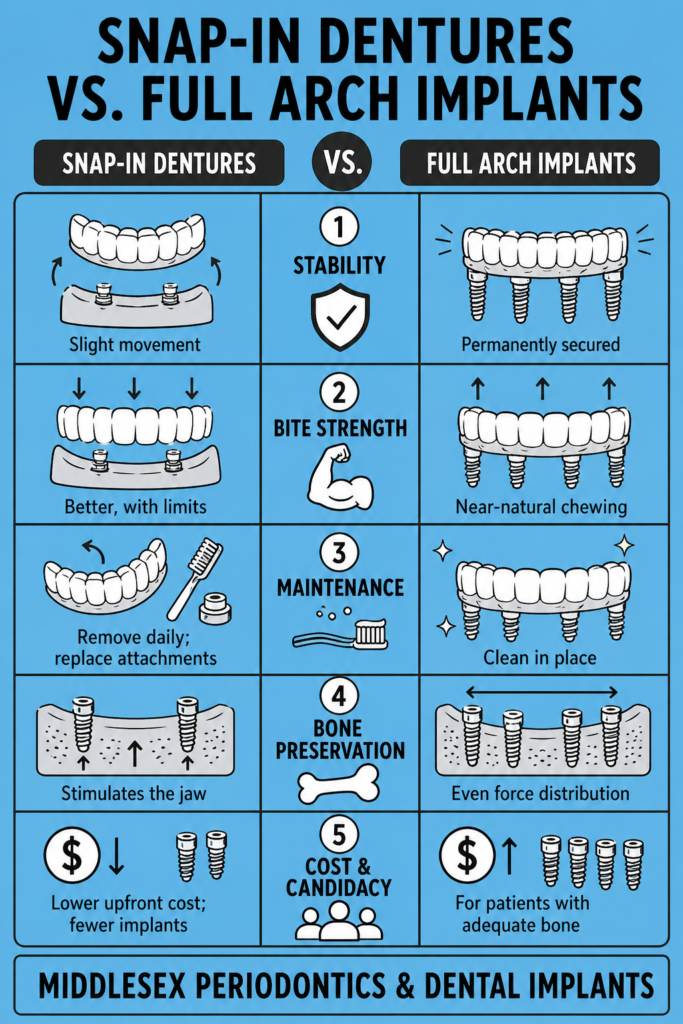
Both options share important qualities, but the right fit depends on your goals, bone volume, and preferences. Here is a breakdown of where they diverge:
- Stability: Fixed full-arch implants are permanently secured; overdentures snap in and out, allowing minor movement under load.
- Bite strength: Fixed implants restore near-natural chewing ability, while overdentures offer significant improvement over traditional dentures but still have some functional limitations.
- Maintenance: Overdentures require daily removal and cleaning, plus periodic replacement of attachments; fixed implants are cleaned in place.
- Bone preservation: Both stimulate the jawbone through their implant anchors, though fixed restorations distribute chewing forces more evenly across the jaw.
- Cost and candidacy: Overdentures typically have a lower upfront cost and require fewer implants, making them more accessible for patients with more significant bone loss.
Discussing these factors with a board-certified periodontist gives you the clearest picture of which option is realistic for your anatomy and long-term goals. You can also review full-mouth dental implant costs to understand better what each path entails financially.
Which Option Is Really Better?
The truth is, one isn’t necessarily “better” than the other for everyone. Full-arch implants are usually the way to go if you want something that feels like your natural teeth, lasts a long time, and you have enough bone for a permanent fix. On the other hand, snap-in dentures provide great stability and comfort without the higher price tag. They’re a solid choice if you prefer being able to remove your teeth or if a fully fixed bridge isn’t the right fit for you.
What matters most is having a thorough evaluation accounting for your bone density, overall health, aesthetic priorities, and budget. Financing options through Cherry Financing can help make either path more accessible, and a consultation is the right first step toward knowing which solution you are actually a candidate for.
Contact Middlesex Periodontics & Dental Implants to Book Your Consultation
Choosing between implant-supported overdentures and full-arch dental implants is a significant decision and deserves a thoughtful, individualized evaluation. At Middlesex Periodontics & Dental Implants, Dr. Reich brings decades of experience in implant placement and full arch restoration to every patient conversation, helping you weigh your options with accurate, practical information.
To find out which path is the right one for your smile, call us at 732-257-7300 or reach out through our contact form to schedule your consultation.